Decentralized Municipal MRF Deployment & City Waste Recovery
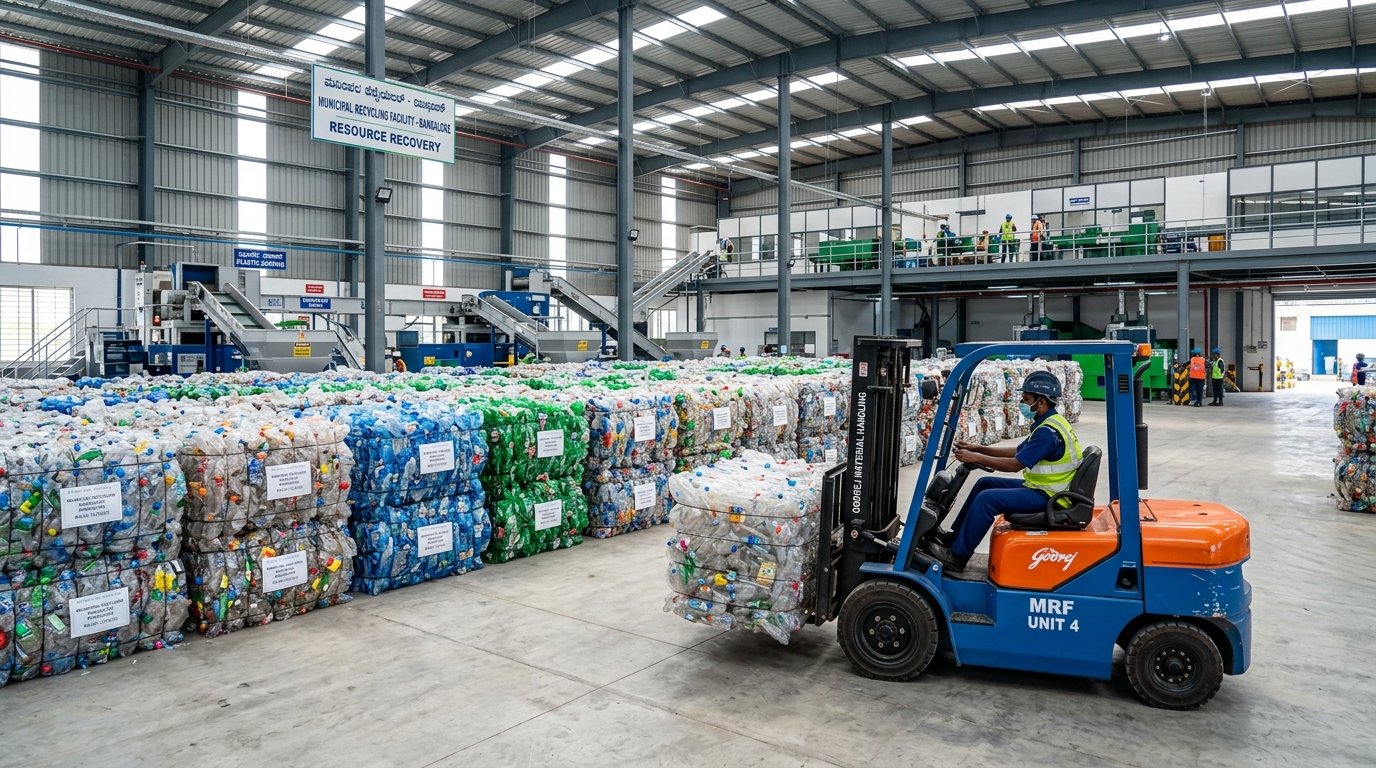
We partner with Municipal Corporations and Smart City Special Purpose Vehicles under Public-Private Partnership (PPP) and DBFO models to finance, construct, mechanize, and operate automated Material Recovery Facilities (MRFs) with guaranteed recyclables off-take.
Step-by-Step Operational Workflow
A fully digitized lifecycle ensuring regulatory compliance, verified mass balance, and zero margin for error.
Waste Characterization & Sizing
Door-to-door dry waste audit, seasonal composition modeling, and modular civil-mechanical facility engineering blueprint.
Site SurveyMechanized Sorting Line Installation
Deployment of optical NIR sorting, ballistic separators, magnetic eddy-current separators, and high-density auto-balers.
High TechDigital Waste ERP & Weighbridge Setup
Cloud-connected inventory management system tracking segregated polymer bales, shift throughputs, and dispatch manifests.
Live TelemetryLong-Term O&M & Off-Take Execution
End-to-end operational management ensuring statutory SWM compliance and guaranteed monetized recyclables off-take.
Zero O&M RiskWhat's Included in Your Service Contract
Every client engagement executed by SHRISTIYAM COMPLIANCE SOLUTIONS PRIVATE LIMITED includes complete audit trails, verified documentation, and statutory legal defense.
Discuss Smart City MRF Partnership
Request a feasibility study, operational blueprint, or PPP model presentation tailored to your urban local body.
Frequently Asked Questions
Key technical and statutory guidance regarding Decentralized Municipal MRF Hubs & City Waste Recovery.
Yes. We deploy modular Material Recovery Facilities (MRFs) under Public-Private Partnership (PPP) and Design-Build-Finance-Operate (DBFO) models. The municipality provides designated land and dry waste collection streams, while SHRISTIYAM COMPLIANCE SOLUTIONS PRIVATE LIMITED installs mechanized NIR optical sorting infrastructure, provides digital ERP telemetry, and monetizes recyclables through guaranteed industrial off-take.
A standard 50 MT/Day automated MRF cluster requires approximately 1.5 to 2.0 acres of designated municipal land, including truck maneuvering bays, mechanized sorting floors, baled storage yards, and administrative offices.
Automated MRFs provide documented 85-94% dry waste diversion from landfills, 100% scientific processing of legacy plastics, live cloud weighbridge telemetry, and formal integration of waste collectors, fulfilling the key criteria of SBM Urban 2.0.
All combustible non-recyclable packaging and textiles are shredded and conditioned into Refuse Derived Fuel (RDF) and dispatched under long-term off-take agreements to cement kilns and captive boilers, ensuring zero waste to landfill.
Blogs of SHRISTIYAM
Authoritative research, regulatory updates, and circular economy intelligence from SHRISTIYAM.

Navigating New EPR Mandates: A Strategic Roadmap for Enterprise FMCG Brands
How progressive enterprise brands are transitioning from compliance risk to value creation by integrating food-grad...

Overcoming Intrinsic Viscosity Loss in High-Performance rPET
Exploring solid-state polycondensation (SSP) and vacuum degassing techniques that maintain structural clarity in re...
Understanding Category I vs. Category II Statutory Targets
A breakdown of recycling quotas, verification obligations, and penalty mitigation across rigid and flexible polymer...